
Stewardship in Daily Decisions: Where Kingdom Economics Really Shows Up!
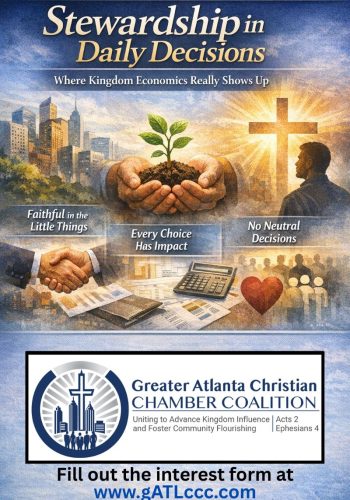
Most business professionals don’t wake up wondering whether they believe in stewardship. We already do. We steward time, money, talent, influence, relationships, and opportunity every day. The real question isn’t if we steward—it’s how, and toward what end.
Jesus puts it plainly in Luke 16:10:
“Whoever can be trusted with very little can also be trusted with much, and whoever is dishonest with very little will also be dishonest with much.”
This verse isn’t about accounting practices alone. It’s about alignment. It’s about what governs our decisions when no one is watching, when the stakes feel small, and when faith seems disconnected from spreadsheets, meetings, and margins.
That’s where Kingdom economics begins—not with grand gestures, but with daily decisions.
Stewardship Is Direction, Not Just Discipline
Many professionals think stewardship means restraint: spending less, working harder, giving more. Those things can matter, but they’re incomplete. Biblical stewardship is not merely about control; it’s about direction. Whose Kingdom is being built through the way I decide, prioritize, and act?
Every decision carries momentum. How you price, hire, promote, negotiate, speak, and plan shapes more than outcomes—it shapes culture. Over time, those “small” decisions create systems that either reflect God’s character or quietly drift away from it.
Luke 16:10 reminds us that faithfulness is cumulative. Trust grows—or erodes—through repetition.
The Myth of “Neutral” Decisions
One of the most common assumptions in the marketplace is that many decisions are neutral—purely practical, value-free, or just “how business works.” Scripture challenges that idea. There is no such thing as a neutral decision when influence is involved.
• How you handle conflict teaches others what power looks like.
• How you define success reveals what you truly worship.
• How you respond to pressure shows who you trust.
Stewardship isn’t reserved for moments of generosity. It shows up when you choose integrity over convenience, long-term impact over short-term gain, and people over performance metrics.
These are Kingdom economics at work—not as theory, but as practice.
Faithfulness in the “Little” Places
Jesus’ emphasis on “very little” is striking. He doesn’t dismiss small responsibilities; He elevates them. Emails. Calendars. Expense reports. Vendor relationships. Follow-through.
In business culture, we often celebrate the big win and excuse the small compromise. The Kingdom reverses that logic. Faithfulness in unseen places is the proving ground for greater influence.
This doesn’t mean perfection. It means intention. It means asking better questions before making routine choices:
• Does this decision reflect trust or fear?
• Does it honor people as image-bearers or reduce them to tools?
• Does it multiply value or merely extract it?
These questions shape leaders who can be trusted with more.
Stewardship Is Communal, Not Isolated
Another misconception is that stewardship is a private matter between you and God. While personal obedience matters, stewardship is deeply communal. Your decisions affect employees, families, neighborhoods, and future leaders.
That’s why Kingdom economics can’t be lived out in isolation. We need language, frameworks, and relationships that help us see beyond immediate outcomes. We need spaces where faith and business are integrated honestly—without hype, guilt, or formulas.
This is where many professionals feel tension. They sense there’s more to faithful leadership than profit alone, but they lack a community that understands both Scripture and the realities of the marketplace.
Why GAC3 Exists
GAC3 exists to help bridge that gap. Not by telling business professionals to abandon excellence or ambition, but by reorienting them toward God’s design for influence, provision, and transformation.
Kingdom economics isn’t about rejecting profit; it’s about placing profit in its proper role—as a servant, not a master. It’s about stewarding capital, creativity, and authority in ways that bless cities, not just balance sheets.
When leaders begin to apply Kingdom principles consistently, something shifts:
• Decisions become clearer, even when they’re costly.
• Success becomes broader, measured in impact as well as income.
• Influence becomes generational, not just personal.
This is how cities are changed—one faithful decision at a time.
An Invitation to Align
If you’re a business professional who senses that your daily decisions matter more than you’ve been taught, you’re right. If you feel called to steward influence for something larger than yourself, you’re not alone.
Luke 16:10 reminds us that trust is built in the small things. GAC3 is about walking that out together – learning how Kingdom economics applies to real-world decisions, real businesses, and real cities.
Join GAC3 to learn how Kingdom economics can transform your daily decisions—and ultimately your city.
Faithfulness starts today, in the decisions already in front of you.
Fill out interest form at https://gATLccc.com
REQUEST: Will you share this post with your network so they can also grow in their faith during 2026?