
Greater Atlanta: Building Trust Through Consistency
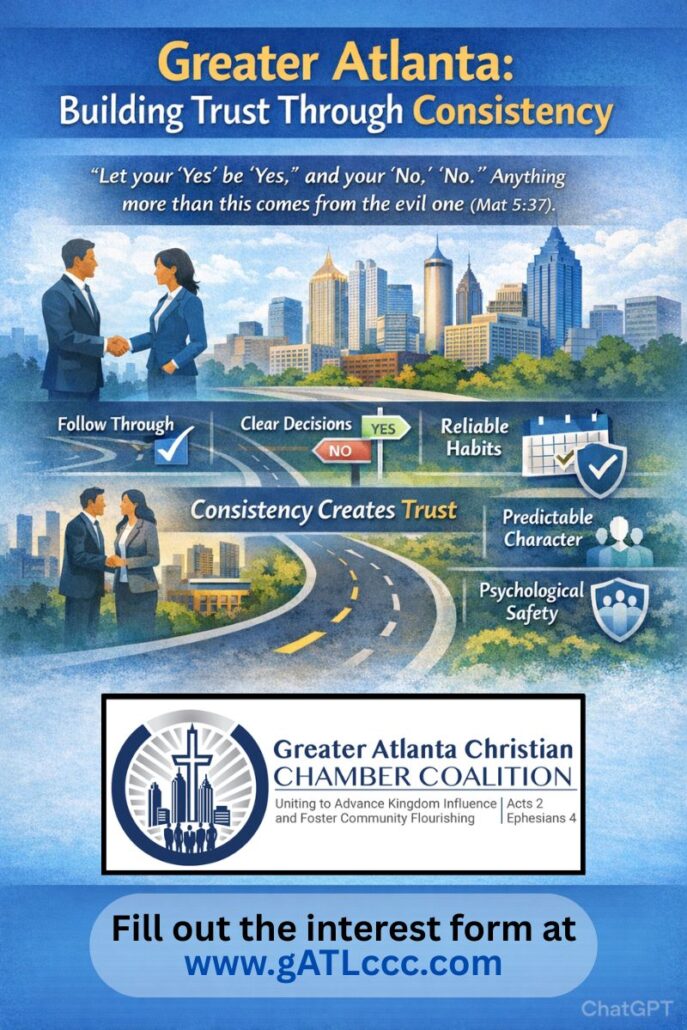
“Let your ‘Yes’ be ‘Yes,’ and your ‘No,’ ‘No.’ Anything more than this comes from the evil one (Mat 5:37).”
Trust is rarely lost in a single dramatic moment.
More often, it erodes quietly: Missed follow-ups, shifting priorities, unclear commitments, and values that sound good, but don’t quite hold up under pressure.
In a region as relationally dense and opportunity-rich as Greater Atlanta, trust is not built by charisma alone. It’s built by consistency; by becoming someone people can count on – not perfectly, but predictably.
Jesus’ words in Matthew 5:37 don’t read like a leadership manual, yet they form one of the most profound foundations for trust in the marketplace. A clear “yes.” A clear “no.” No excess. No spin. No hidden clauses. That kind of clarity creates safety – and safety is where trust takes root.
Habit Formation: Where Trust Actually Starts
Consistency doesn’t begin with reputation. It begins with habit.
Our habits quietly train others how to experience us. Do we follow through? Do we respond? Do we show up prepared? Do we keep small commitments even when no one is watching?
In professional life, we often celebrate big wins and visible milestones. But trust is usually built in the smaller, repeatable behaviors: how we handle routine meetings, deadlines, and decisions that never make a highlight reel.
Greater Atlanta’s business ecosystem runs on relationships that stretch over years, not quarters. Habit formation becomes a form of leadership discipleship: What you repeat shapes who you become, and what others come to expect from you.
Over time, people stop asking whether you’re talented and start asking whether you’re reliable….and that’s a far more powerful question.
Reliability Signaling: Trust Without the Marketing
Trust isn’t declared; it’s inferred.
Reliability sends a signal long before a value statement ever does. It says: You don’t need to brace yourself here. You can relax. This person does what they say.
Inconsistent leaders (even well-intentioned ones) create friction: Teams hesitate. Clients double-check. Partners keep backup plans. Energy that could be spent building gets redirected toward protecting.
Matthew 5:37 invites us into a simpler, more grounded form of credibility. No over-promising. No inflated language. Just alignment between words and actions.
In Greater Atlanta – where introductions travel fast and reputations travel faster – reliability becomes a form of relational stewardship. Each kept commitment quietly compounds trust. Each broken one draws from that account.
Predictable Character and Psychological Safety
Consistency doesn’t mean rigidity. It means integrity across changing circumstances.
Predictable character allows others to know how you’ll respond when things get complicated. Will you move the goalposts? Will values bend under pressure? Will expectations shift depending on who’s in the room?
When character is unpredictable, people protect themselves. When character is steady, people collaborate more freely: They bring ideas. They take risks. They speak honestly.
Consistency communicates safety because it reduces uncertainty. People don’t fear surprises. They know what kind of leader, partner, or colleague they’re engaging with.
That kind of predictability doesn’t limit influence….it expands it.
Where the Gaps Become Evident
Most gaps in consistency don’t announce themselves. They whisper.
- The email you meant to answer.
- The deadline that quietly slipped.
- The standard that wasn’t applied evenly.
None of these feel catastrophic in isolation. But together, they shape a narrative others are paying attention to….even if they never name it aloud.
In Greater Atlanta’s interconnected marketplace, these gaps don’t stay hidden for long. But here’s the hopeful part: gaps also reveal opportunity. They show us exactly where formation is still needed, and where trust can be rebuilt with intention.
Consistency is not about perfection. It’s about direction.
Consistency as Formation, Not Performance
For faith-driven professionals, consistency is more than strategy – it’s formation.
When our yes is trustworthy, our faith becomes visible without needing explanation. When our actions match our words, leadership becomes less about image and more about integrity.
Matthew 5:37 calls us away from performative credibility and toward embodied faithfulness: Less noise. More clarity. Less impressing. More becoming.
In Greater Atlanta, the leaders who shape culture most deeply are often the steadiest ones. The ones whose presence lowers anxiety. The ones who make trust feel normal.
That kind of consistency doesn’t happen by accident. It’s formed—together.
Suggested Prayer
God, form my character where no one is watching. Align my words and actions so my “yes” brings peace and my “no” brings clarity. Make me a steady presence that reflects Your faithfulness in every space I lead. Amen.
Growth Activity
This week, identify one small commitment you can make – and keep – without exception. Notice how consistency in something simple begins to build trust in larger spaces.
NEXT STEPS:
If you want to become a steady, trustworthy presence in your circles, GAC3 walks with you in that formation. Please fill out the form to join with us at https://gATLccc.com
REQUEST: Will you share this post with your Atlanta network so they can also grow in their faith during 2026?